

The outreach programme Segobriga proposes aims to disseminate, in an appropriate, accessible and understandable way to the general public, the significance of the archaeological site at Segobriga and its Archaeological Park on a social level with the carrying out of different activities to disseminate it, such as conferences, talks and colloquiums, as well as the organisation of activities at the archaeological site itself and the execution of projects that promote the dissemination of the site.
In addition, alliances are made with different cultural associations and local administrations in the region and the province in order to "add" support for the implementation of the activities.
The Segobriga Archaeological Park dissemination programme also aims to provide visitors with an in-depth knowledge of the excavated buildings through the transmission of archaeological data extracted from the excavations carried out at the archaeological site over the last 60 years; thus, the annual dissemination calendar includes several guided visits by specialists linked to archaeological research at the site.


The new demands of society have led cultural institutions to give more and more prominence to their educational function, and in recent years they have become a widely used complement to education in schools.
Following this line, the Archaeological Park of Segóbriga, through its educational dissemination plan, pursues the following objectives:
Under the title, Segobriga explains how to y Segobriga tells you workshops and educational visits have been designed for schools visiting the Archaeological Park in spring and autumn. The educational levels of the Park's educational proposal are as follows:
Guided tours and workshops can be booked through the visitor information service on 629 752 257 and/or segobriga@dipucuenca.es. For groups of 25 students or more, with prior booking.
The new demands of society have led cultural institutions to give more and more prominence to their educational function, and in recent years they have become a widely used complement to education in schools.
Following this line, the Archaeological Park of Segóbriga, through its educational dissemination plan, pursues the following objectives:
Under the title, Segobriga explains how to y Segobriga tells you workshops and educational visits have been designed for schools visiting the Archaeological Park in spring and autumn. The educational levels of the Park's educational proposal are as follows:
First cycle (6 to 8 years old)
Segobriga explains how to The Romans used to dress
Segobriga tells you What was their source of wealth
Second cycle (from 8 to 10 years old)
Segobriga explains how to An archaeological excavation is carried out
Segobriga tells you A day at the amphitheatre
Third cycle (from 10 to 12 years old)
Segobriga explains how to An archaeological excavation is carried out
Guided tours and workshops can be booked through the visitor information service on 629 752 257 and/or segobriga@dipucuenca.es. For groups of 25 students or more, with prior booking.
The landscape that can be seen from the archaeological site of Segobriga is very well preserved, with no significant alterations since Roman times.
Its typology corresponds to rural landscapes, with the peculiarity of being in an area of contact between the plains of La Mancha and the Iberian system, shaped in the recent past and today by the river Gigüela, a tributary of the Guadiana.
For this reason, the Archaeological Park carries out annual environmental activities aimed at guaranteeing the conservation of the natural values and resources of the Park's protected area, with special attention to the landscape and the creation of plant formations.

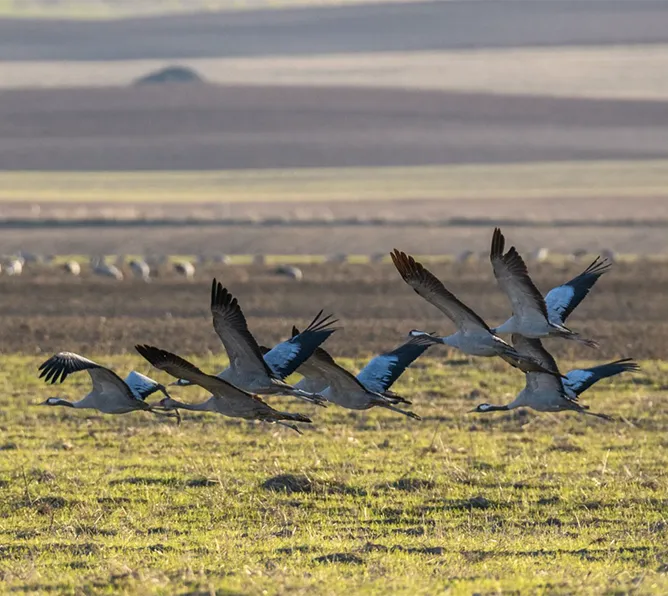
El Hito Lagoon is one of the few remaining examples of temporary saline wetlands in SpainThe remaining ancient inland seas, where endemic plant and insect species of great uniqueness thrive.
Located in the heart of Mancha Alta ConquenseIt is one of the most emblematic nature reserves in Castilla-La Mancha.
More information and reservations:
equilis@fundacionglobalnature.org | (+34) 659 831 821
OPENING HOURS:
MONDAY TO FRIDAY FROM 09:00 TO 15:00 H.

Ctra. Carrascosa de Campo a Villamayor de Santiago, s/n, E-16430 Saelices (Cuenca).
Telephone Interpretation Centre: 629 75 22 57
Mail: segobriga@dipucuenca.es
Design and implementation: Tragsa Group. Contents: Rosario Cebrián Fernández (Lecturer in Archaeology at the UCM) with the collaboration of the Tragsa Group.
All content and images on this website are protected by copyright. Use without consent is prohibited.
