Archaeological Park of
Segóbriga
The archaeological site is one of the most important archaeological complexes on the Meseta. The monumentality of its excavated remains, where all the public buildings, essential references of Roman architecture, are present, has turned Segobriga into a unique site for understanding the urban characteristics of this period, as it does not have any superimposed modern city. In addition, the surrounding landscape, which has remained practically intact since Roman times, helps to contextualise and understand the city, its space outside the walls and the territory.

With weather warning of orange levelmajor risk (according to the AEMET), the visit to the archaeological park may be altered, suspended or modified by unusual weather phenomena and with a certain degree of danger for the usual activities.

THE ARCHAEOLOGICAL PARK OF SEGÓBRIGA

From an Iron Age castro on the hill of Cabeza de Griego, in Saelices, arose the Roman town of Segobriga.

The "ruins of Cabeza de Griego" were declared a national historical monument by decree of 3 June 1931, and therefore an Asset of Cultural Interest. The first archaeological work was carried out in the 1950s, but it was not until 1961 that the archaeologist Martín Almagro Basch began to work on the archaeological site, to which we owe the fact that he laid the foundations, with great foresight, for its study and cultural valuation. He did so with the support of Francisco Suay from Cuenca, who together also collaborated in the creation of the Archaeological Museum of Cuenca.

The excavation and restoration of the main monuments of the Roman city, the theatre and the amphitheatre, began on that date, followed by other excavation campaigns, which increased the excavated area, its value and the visit to the buildings and spaces that today form part of the tour of the archaeological site. This archaeological research work continues at the site with summer excavation campaigns.

In 1975 the Museum of Segóbriga was inaugurated, the current Museum of the Epigraphs, a small facility, which functioned as a Site Museum, until the opening of the Archaeological Park.

The Junta de Comunidades de Castilla-La Mancha created five Archaeological Parks, one in each province. Their purpose was to bring the rich archaeological heritage of the Region closer to society within its own historical and geographical environment, in order to facilitate its understanding through contemplation and explanation in situ. In 2002, the first of these sites, the Parque Arqueológico de Segóbriga, opened its doors to the public.

The archaeological remains of ancient Segobriga form part of this Park, which articulates all the services provided to visitors. An Interpretation Centre, located at the entrance to the Park, is the beginning and end of the circular route designed to discover the archaeological site, which includes 16 buildings and spaces that can be visited.

Segobriga, your Roman history awaits you!
INTERPRETATION CENTRE

In the year 2000, work began on the construction of the Park Interpretation Centre, a new building that would replace the small museum installation, now converted into an epigraphic museum, housing and a warehouse for the storage of archaeological materials.

ACTIVITIES

SUMMER CONCERTS

During the summer, the Park hosts different musical activities to enjoy a spectacular setting...

EDUCATION

The new demands of society have led cultural institutions to give more and more attention to the...

SEGÓBRIGA PROPOSES

The outreach programme Segobriga proposes aims to disseminate information, in an appropriate manner...

SUSTAINABILITY AND ENVIRONMENT

The landscape that can be seen from the archaeological site of Segobriga is very well preserved...

GUIDED VISIT TO EL HITO LAGOON NATURE RESERVE

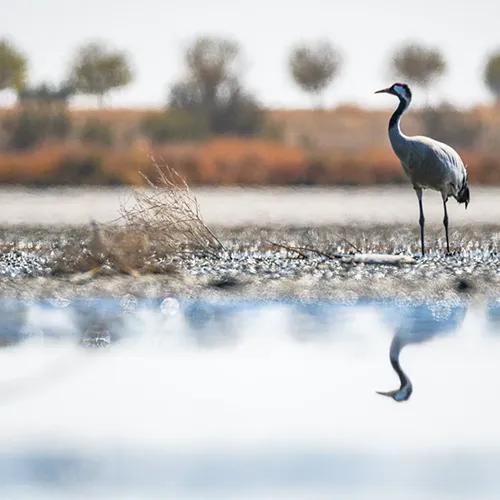
El Hito Lagoon is one of the few examples of temporary saline wetlands remaining in Spain. Free visit. (See web)

SITE

Located in the municipality of Saelices, the Archaeological Park of Segóbriga is one of the most important archaeological sites from the Roman period in Spain. The site has been known since 1546, when the doctor from Alcarria, Luis de Lucena, became the first scholar to visit it. The archaeological discoveries that were made by chance in 1760 marked the beginning of a fruitful period in the knowledge and research of the site. Segobrigawhich continues to this day. Located in the region of La Mancha Alta, its undulating landscape of holm oak groves and unirrigated crops, crossed by the river Gigüela, forms the ancient landscape of Segobriga.

ORGANISE YOUR

VISIT

Audio guides

Visitors have at their disposal an audio guide service in English and Spanish to help them understand the visit better. You can listen to it or download it here.
Available English Audioguide

Brochures

We provide visitors with various downloadable brochures to help them visit the park.

Click on the button below to access the download section.

Timetables

Winter timetable

(from 1 October to 31 March): Tuesday to Sunday, from 10:00 to 18:00 (last access at 17:00).

Summer timetable

From 1 April to 30 June: Tuesday to Sunday, 10.00–19.30 (last admission 18.30)

From 1 July to 12 August: From 9:00 to 15:00h (last access at 14:00h)

From 13 August to 30 September: Tuesday to Sunday, 10.00–19.30 (last admission 18.30)


Tariffs

Consult all available rates. Prices vary for individual visits, groups, schools with or without guided tour or even residents of Almonacid del Marquesado and Saelices.

Dogfriendly

Well-behaved dogs are welcome at the Segóbriga Archaeological Park. Consult all the rules for your pet to enjoy the past in the ancient Roman city of Segóbriga.

ReAdd to Segobriga

The Archaeological Park of Segóbriga offers visitors an application for Android devices that helps, through augmented reality, to learn first-hand about the Archaeological and Natural Heritage of Segóbriga. Segóbrigaas it was. A new way of recovering and understanding history.

COME AND SEE

Segóbriga

Contact. Information and reservations:

Archaeological Park of Segóbriga Ctra. Carrascosa de Campo a Villamayor de Santiago, s/n, E-16430 Saelices (Cuenca). Telephone Interpretation Centre: 629 75 22 57 Mail: segobriga@dipucuenca.es

Ctra. Carrascosa de Campo a Villamayor de Santiago, s/n, E-16430 Saelices (Cuenca).
Telephone Interpretation Centre: 629 75 22 57
Mail: segobriga@dipucuenca.es

Credits:

Design and implementation: Tragsa Group. Contents: Rosario Cebrián Fernández (Lecturer in Archaeology at the UCM) with the collaboration of the Tragsa Group.

All content and images on this website are protected by copyright. Use without consent is prohibited.